Table of Contents
Object: Sub-Process
In its basic characteristics, the sub-process corresponds to an independent process. In a sub-process, related tasks are bundled and arranged underneath a main process. Since a sub-process is a stand…

Table of Contents

In its basic characteristics, the sub-process corresponds to an independent process.
In a sub-process, related tasks are bundled and arranged underneath a main process.
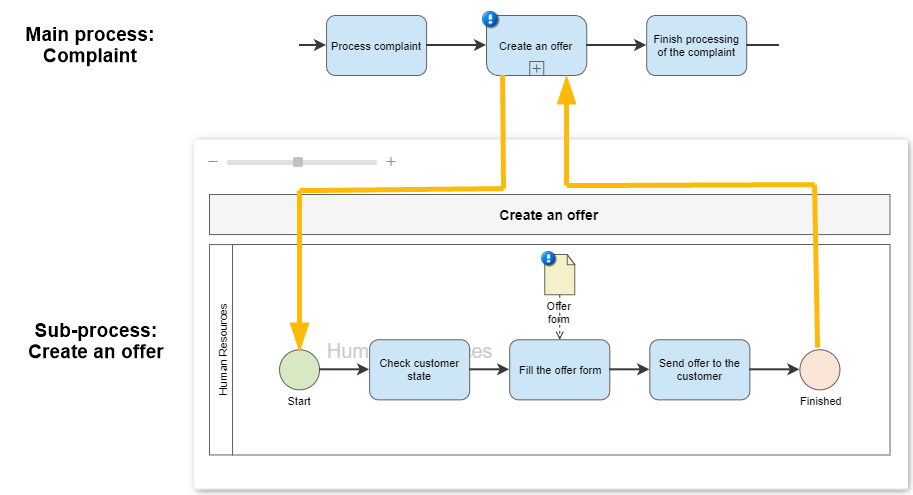
If the object 'sub-process' is reached in the flow of a main process, all tasks between the start and end event of the sub-process are executed first. When these are completed, the tasks of the main process are continued.
- ...a new offer is created from a superordinate process "Complaint" to appease an unsatisfied customer.
- ...a new offer is created from a superordinate process "Sales" for a current prospect.
Convert sub-process to process
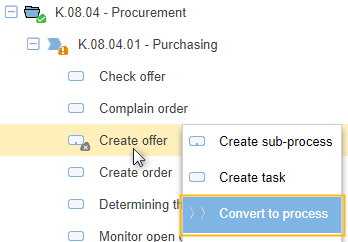
In order to be able to use a sub-process as a freestanding process (e.g. to place it in a process group), it is necessary to convert it into a process. The corresponding option can be found by right-clicking on the sub-process in the Process Explorer.
Activity marker
With a right click on a sub-process in the Process Designer it is possible to define if and how this sub-process is executed repeatedly.
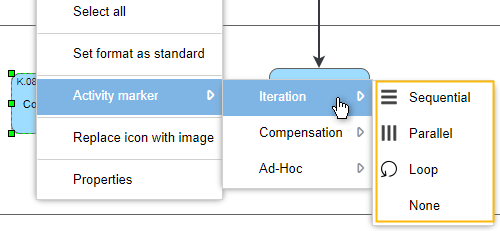
Sequential | A sub-process that is repeated as many times as the given situation requires. Executions are done one by one and the amount of repetitions can be determined right at the beginning.
|
Parallel | A sub-process that is repeated as many times as the given situation requires. Executions are all done in parallel and the amount of repetitions can be determined right at the beginning.
|
Loop | A sub-process that is performed repeatedly until a defined goal is achieved. Performances occur one at a time and the amount of repetition is not predictable at the beginning.
|
None | A sub-process that is performed once. |
Compensation | Use in combination with the compensation event: An activity that must be able to be canceled or reversed at a later point in time (marked with the event). |
Ad-Hoc | Ad hoc sub-processes identify a section in which the contained activities (tasks or sub-processes) can be executed as follows:
|


How did we do?
Object: Task
Object: Connectors
